
Andromeda (transcreation and interpretation); Utopia (video production)
Client: Seattle Department of Transportation (SDOT)
Services: Research · Strategy · Creative · Multicultural Media · Community Engagement · Reporting
Sector: Transportation
Executive Summary
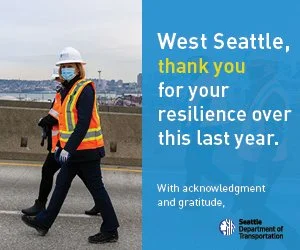
When cracks closed Seattle's busiest street in 2020, SDOT had to keep more than 100,000 daily travelers informed for more than two years. Vida built equity into the response from the inside out: training the project team in racial equity, listening to impacted communities, and delivering multilingual communications in up to ten languages. The program drew 5 million+ ad impressions, 200,000+ web page views, and 10,000+ email subscribers, and community insight shaped the City's Mobility Action Plan.
Introduction
The West Seattle Bridge was historically Seattle's most used street, carrying more than 100,000 travelers a day. Built in 1984, it was the main route for people and goods moving to and from West Seattle. In 2020, SDOT closed the high bridge after inspections showed rapidly growing cracks.
The closure hit West Seattle hard, along with the neighboring communities of South Park, Georgetown, and SODO. Many of the people most affected were BIPOC residents, immigrant families, and small businesses that public outreach has historically left out. SDOT needed to balance a complex engineering fix with real social and economic impacts, and keep every community informed along the way.
The process: How we built belonging
L - Local Insight
An emergency that hit some communities harder
Detours and longer commutes affected everyone. But residents and businesses in the Duwamish Valley, Georgetown, and South Park already faced health and economic disparities, and were often missing from public processes. Technical updates in English alone would not reach them. SDOT also needed its own team ready to weigh community impacts alongside engineering decisions.
O - Observation
Listening inside and out
Vida started inside SDOT. We designed and led a weekly racial equity training for more than 30 SDOT staff and project partners. Grounded in Indigenous Circle methodologies, the sessions explored Seattle's history of racism, discriminatory housing and land-use policies, and how budget and design decisions have shaped community health and economic well-being.
At the same time, Vida listened to the community. We held 10 focus groups and more than 60 one-on-one conversations with residents and businesses in West Seattle, the Duwamish Valley, and Georgetown. We also led outreach, group discussions, and surveys with people affected by the closure.
C - Co-Creation
Community voices in the plan
Those conversations became community personas that captured the distinct transportation and economic needs of each neighborhood. The personas shaped strategy for the City's Mobility Action Plan, putting the needs of those most affected directly into planning.
Inside SDOT, the training changed how the team worked. It shifted decision-making practices to better balance technical expertise with community knowledge.
A - Amplification
Clear, multilingual updates for more than two years
Vida built an equitable communications plan that put historically excluded communities first. Materials ran in up to ten languages, with transcreation and live interpretation from Andromeda. Every channel pointed back to a central website with pages in eight priority languages.
Videos: Produced 19 bridge repair progress videos, bridge repair method explainers, and a multilingual virtual walking tour of the West Marginal Way project. Each turned technical work into plain language.
Narrated slide decks: Bridge reopening updates in 10 languages, built as audio-visual tools for non-English speakers and community hubs.
Blog and email: 60 blog posts and 199 email updates, including weekly updates during active construction.
Digital ad campaigns: Five campaigns invited people to the virtual open house, encouraged them to "flip their trips," reminded drivers about low bridge restrictions, and announced the reopening date.
The Don't Go Low campaign warned drivers about new citations for unauthorized vehicles on the low bridge. Display ads ran in eight languages across West Seattle and the city. Digital out-of-home ads appeared at gas pumps, ATMs, and convenience store checkouts near the bridge. Connected TV ads in English, Spanish, and Vietnamese reached viewers on streaming apps.
L - Lasting Impact
Trust built during a crisis
SDOT's audience grew throughout the closure. The email list passed 10,000 subscribers by fall 2022, the website drew more than 200,000 page views, and blog posts were shared more than 29,000 times. More than 30 staff and consultants completed equity training that changed how the team made decisions. Community insight now lives in the City's Mobility Action Plan.
Results: Real results, measurable impact
5 million+ digital ad impressions and 15,000+ clicks across five campaigns
200,000+ website page views
~20,000 views of 19 bridge repair progress videos
2,400+ views of narrated reopening decks in 10 languages
Conclusion: Local impact, anywhere.
In an emergency, the communities hit hardest are often the last to hear what is happening. Vida made sure they were the first: in their language, through people they trust, and inside the decisions that affected them. That is how we work: equity is not an add-on to infrastructure; it is how infrastructure earns trust.