
Standard display advertising delivers a multicultural CTR around 0.20%.
A 0.20% click-through rate doesn't turn heads in most utility marketing meetings. It's the accepted cost of reaching multicultural audiences through standard media buys: low, expected, and rarely challenged. Most marketers budget around it, defend it to leadership, and move on.
At Vida, we don't accept that benchmark or take the standard approach. Not because ambition sounds good in a proposal. Because the benchmark itself is broken.
Here's the real question: why does "multicultural CTR" get treated as its own separate, lower category in the first place? The answer isn't that multicultural audiences engage less. It's that most campaigns were never built for them. Translated creative. Generic media buys. Messaging tested on one audience and pushed out to everyone else. That's not underperformance—that's the predictable result of an outdated, ineffective approach.
What Counts as a Multicultural CTR Benchmark?
A multicultural CTR benchmark measures how often people in a specific cultural or language community click on a digital ad, compared to impressions delivered. The commonly cited industry standard is around 0.20% for display advertising, a figure most agencies treat as a ceiling instead of a starting point.
That benchmark exists because most multicultural campaigns are built the same way: take a mainstream creative concept, translate the copy, and place it in front of a "diverse" audience segment. The creative was never co-created. The media plan was never built around where that community actually spends its time and attention. The result gets logged as the expected outcome for multicultural outreach, and the bar stays on the floor.
How Do We Consistently Outperform the Standard?
When we partnered with the Washington Health Benefit Exchange (WAHBE) to close the gap between healthcare eligibility and enrollment in immigrant communities, the brief was clear: trust was low, the system felt hard to navigate, and standard outreach wasn't moving the needle.
Our approach didn't start with a media plan. It started with the communities WAHBE needed to reach.
Targeted multicultural media. We partnered with trusted outlets serving Spanish-, Chinese-, Vietnamese-, and Russian-speaking communities and delivered in-language messaging across social, display, CTV, and landing pages. Not translated messaging; in-language messaging built for each audience.
Localized earned media. Ten media interviews ran across English, Spanish, Chinese, and Vietnamese, building awareness through real conversations instead of paid impressions alone.
Community-led creative. "Healthcare for all" showed up in murals painted by and for the priority audience, in the neighborhoods they call home.
The result: 8.4 million digital impressions, 5.6 million multicultural media impressions, and 85,171 in-language landing page visitors — 61% of total campaign traffic. Click-through rates exceeded industry benchmarks. Enrollments hit 309,000, with 49,000 first-time sign-ups.
The lesson? If your priority audience has historically been treated as an afterthought rather than the primary audience, you must choose community-led media targeting over translated mainstream creative. That's the decision criteria. Translation gets the words right. Co-creation gets the culture right—and culture drives the click.
How This Applies to Utility Marketing
Utility marketers and communicators face this same gap every day. Program adoption for energy efficiency rebates. Rate increase notices. Emergency and wildfire alerts that must reach non-English-speaking households in minutes, not days. When multicultural households don't engage with these campaigns at the same rate as general-market households, the instinct is to blame the audience. We tell ourselves they're low-interest, low-trust, hard to reach.
The data says otherwise. The audience isn't the key variable. The approach is.
A utility running a clean energy program adoption campaign built on the same translated-creative, generic-media-buy model will likely land near that 0.20% benchmark and will likely need to defend that number in a rate case or before a state commission. But a campaign built on trusted, hyperlocal media relationships and creative shaped for the community it serves has a documented path to something closer to what WAHBE achieved.
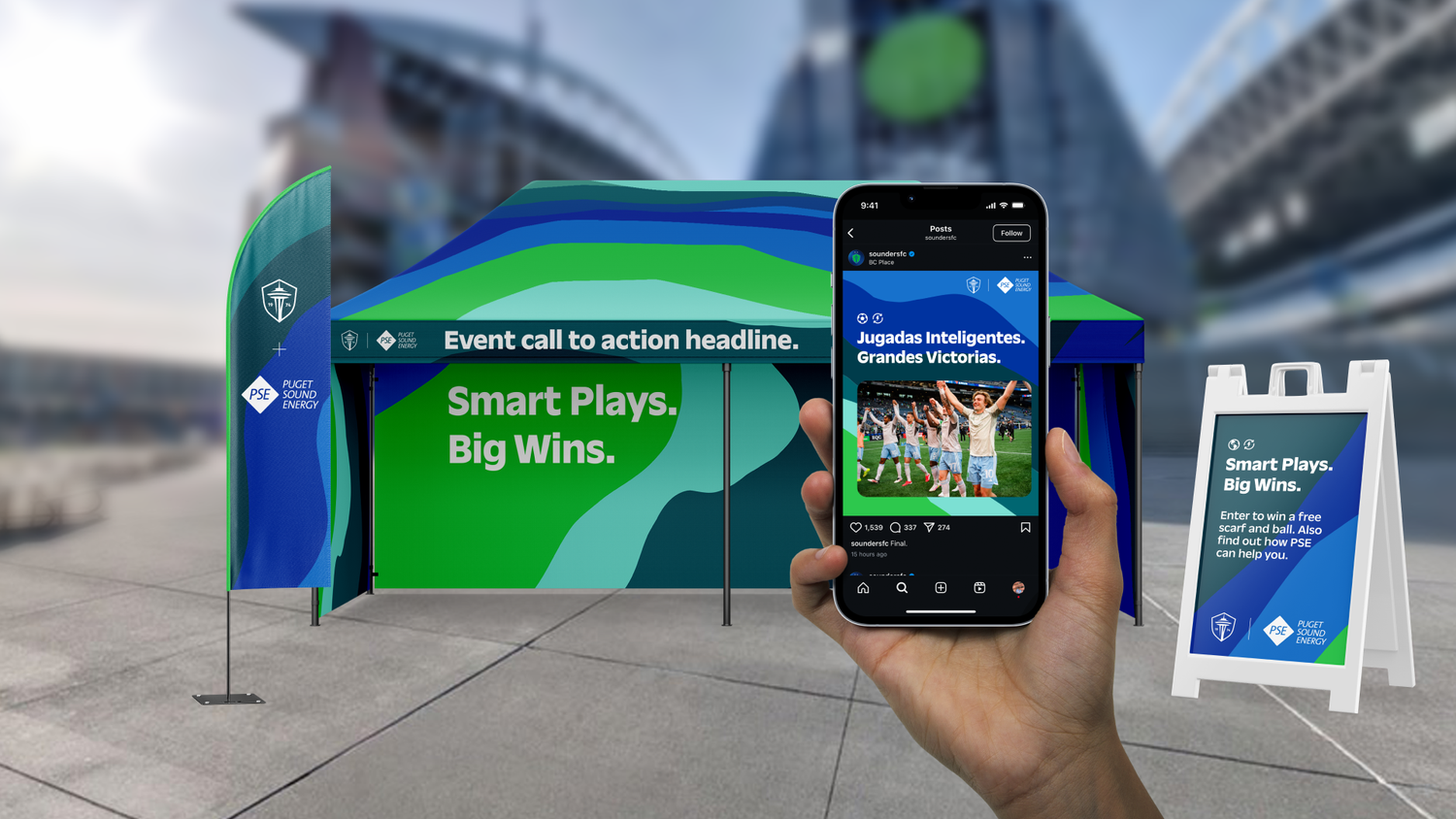
Our Puget Sound Energy × Sounders FC campaign is proof: by meeting Spanish-speaking households inside a cultural moment they already trusted, we drove 1,000 ticket claims through quiz engagement in under 12 hours, recorded 250+ documented interactions with PSE energy efficiency content, and turned a single-season effort into a five-year partnership, none of which a translated flyer and a generic media buy were going to deliver.
That kind of engagement isn’t a fluke. It's what happens when outreach is built with a community instead of aimed at it.
This matters most where the stakes are highest: wildfire and emergency alerts. A multilingual household that doesn't click, open, or act isn't just a missed conversion. It's a safety failure. The PSE × Sounders FC campaign shows what's possible when the approach is right: 1,000 ticket claims in under 12 hours and 250+ documented household interactions with energy-efficiency content—driven not by a mass-translated alert, but by a campaign built inside a cultural moment the community already trusted. The same principle that drove WAHBE's 309,000 enrollments and PSE's five-year partnership applies directly to crisis communication: trusted local media and co-created messaging reach people that a mass-translated alert does not.
The Performance Case
These are Vida’s documented outcomes across the many utility projects we’ve worked on, not aspirational projections.
3.7M+ reached on PSE's Siempre Contigo campaign — 42% above projections
0.78% CTR across multicultural digital campaigns, versus the 0.20% standard — nearly 4x the benchmark
6x the engagement of PSE's prior Spanish-language campaign
54.2M+ impressions across 28 PSE campaigns in a single year
90% drop in community unfamiliarity with clean energy terms, measured before and after
100% retention of community advisors through year-end
These numbers reflect our unique LOCAL methodology, which positions community members as co-creators, and a media network built on trust, not just placement.
It’s Time to Stop Treating 0.20% as the Ceiling for Multicultural Engagement
If you want to surpass the industry-standard CTR for multicultural campaigns, ask your current outreach partner one simple question: Was this creative co-created with the community it targets, or translated for it? The answer determines which benchmark applies.
When your enrollment numbers, program adoption rates, or emergency response metrics in multicultural communities have plateaued, that's not a sign your audience is disengaged. It means the campaign was never built for them in the first place.
If you’re ready to break the multicultural engagement glass ceiling in your next utility campaign, we’re ready to help you dismantle the default.
Frequently Asked Questions
What is a typical multicultural CTR benchmark in digital advertising?
The commonly cited industry standard for multicultural display advertising is approximately 0.20%. Agencies widely use this figure as the expected performance baseline for standard media-buy campaigns targeting multicultural audiences.
Why do multicultural campaigns often underperform compared to general-market campaigns?
Underperformance typically stems from approach, not audience. Campaigns that rely on translated mainstream creative and generic media placements, rather than creative and channels built specifically for the target community, consistently underdeliver relative to their potential.
What made Vida’s WAHBE campaign exceed industry benchmarks?
The campaign combined original, in-language creative (not translated creative), trusted multicultural media placements, localized earned media across four languages, and community-created content like neighborhood murals. Click-through rates exceeded industry benchmarks, and the campaign drove 309,000 Qualified Health Plan enrollments — the highest in WAHBE history.
Does this benchmark gap apply specifically to utility marketing?
Yes. Utility program adoption, rate case communications, and — critically — wildfire and emergency alerts all depend on effectively reaching multilingual households. The same co-creation approach that drove WAHBE's enrollment numbers applies directly to utility outreach and crisis communication.
What's the risk of continuing to accept the 0.20% benchmark?
Beyond underperforming budgets, the risk is real-world impact: missed program enrollments, weaker rate case defensibility around outreach spend, and — in emergency scenarios — households that don't receive critical safety information in time.
Who is this benchmark comparison most relevant for?
Utility communications, marketing, and community affairs leaders responsible for outreach, program adoption, and regulatory-facing engagement metrics will find this comparison most directly applicable to their budget justifications and campaign planning.